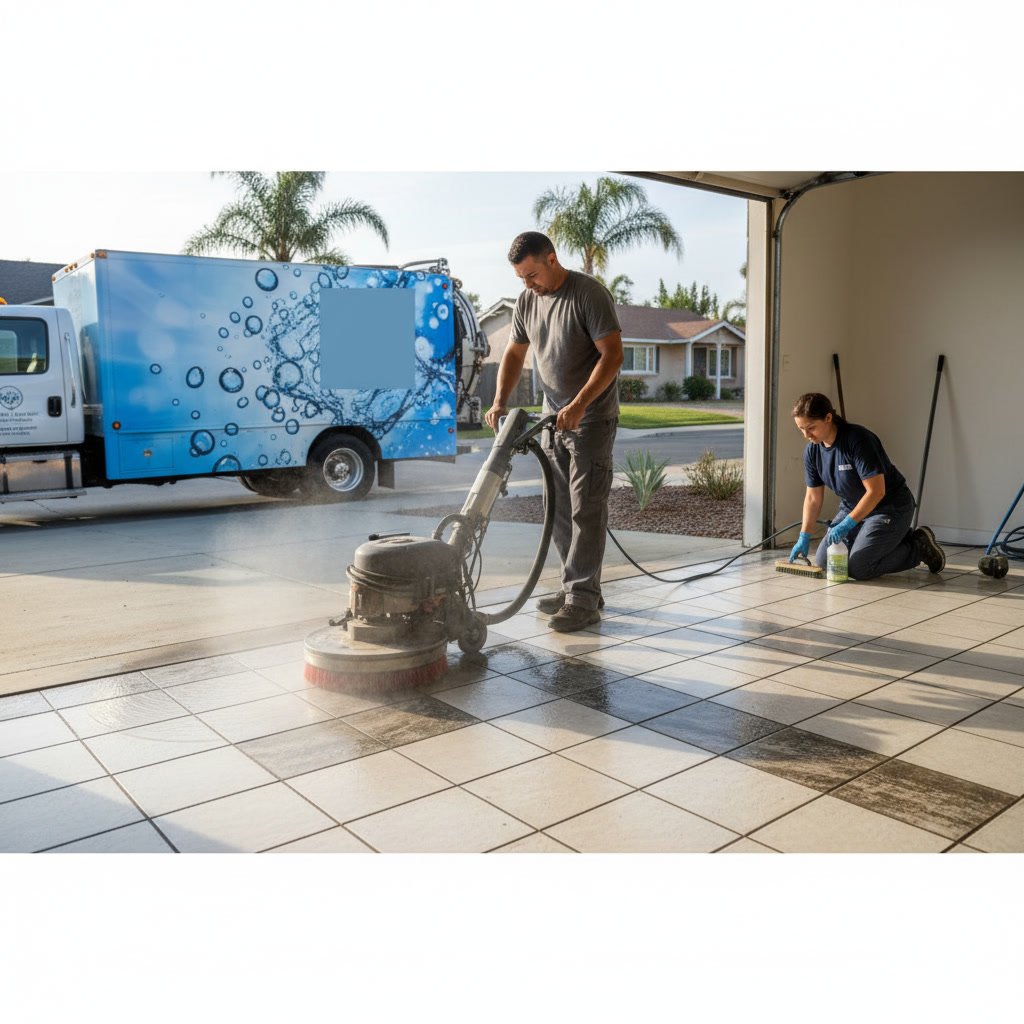
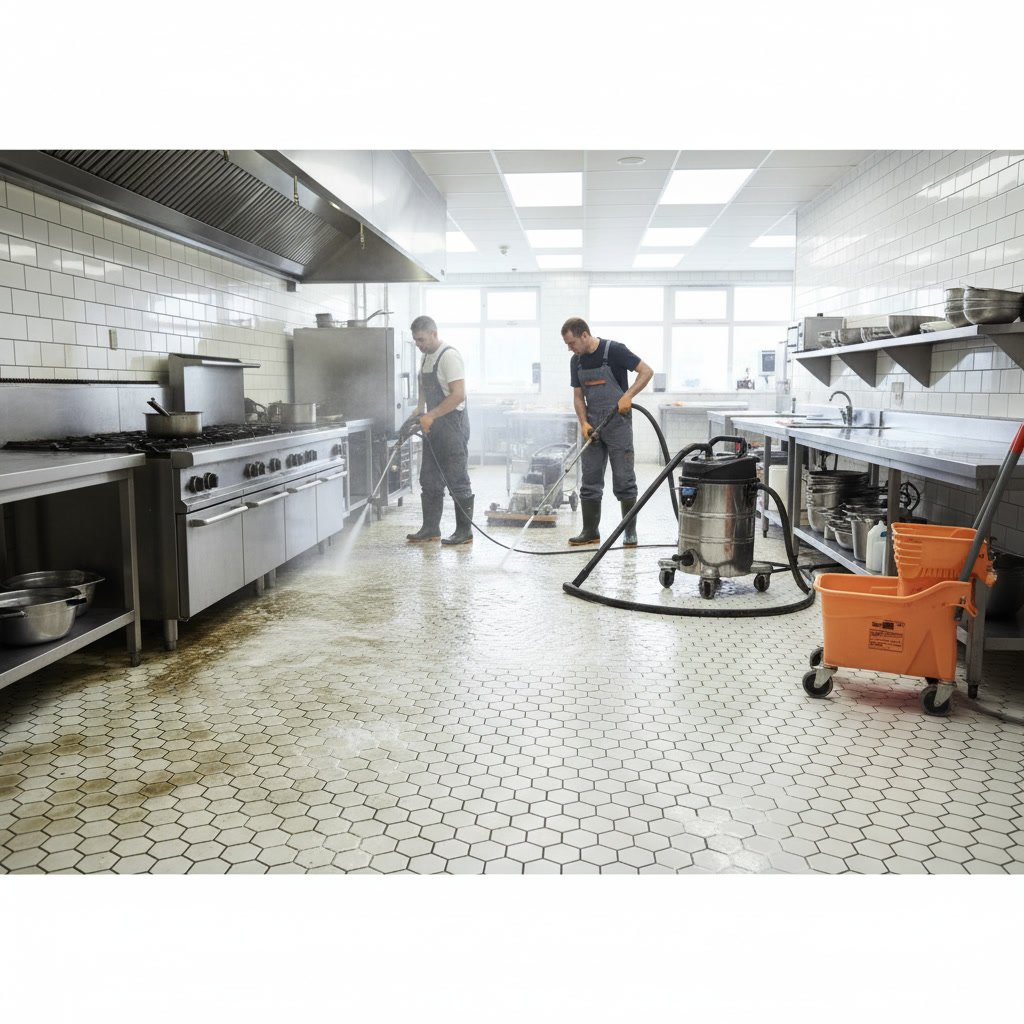
Restaurant kitchen floors take a beating every single day. Grease, food debris, constant foot traffic, and high temperatures create a perfect storm for dirty tile and deeply stained grout. When health inspectors walk through your doors, they look at your floors first. Discolored grout lines and slippery tiles signal bigger problems. Professional commercial tile cleaning restaurant services address these issues directly, restoring sanitary conditions and helping your kitchen pass inspections with confidence.
This guide covers everything restaurant owners and managers in Escalon and Patterson need to know about maintaining clean, safe kitchen floors. You’ll learn why standard mopping fails, what professional cleaning involves, how often to schedule service, and what to expect in terms of cost and results.
Why Standard Mopping Fails in Restaurant Kitchens
Most restaurant staff mop floors daily, sometimes multiple times per shift. Despite these efforts, grout lines turn dark brown or black within months. The tile surface develops a sticky film that attracts more dirt. Slip-and-fall incidents increase.
Standard mopping only addresses surface-level dirt. Grease, oils, and organic matter penetrate porous grout within minutes of hitting the floor. Once embedded, these contaminants resist regular cleaning products. Water and basic degreasers can’t reach deep enough to extract what’s trapped inside the grout matrix.
Restaurant kitchen conditions accelerate this deterioration. Temperatures often exceed 80 degrees, which opens grout pores and allows faster absorption. Steam from cooking equipment adds moisture that encourages bacterial growth. High-traffic patterns in front of fryers, grills, and prep stations wear away grout sealant within weeks, not months.
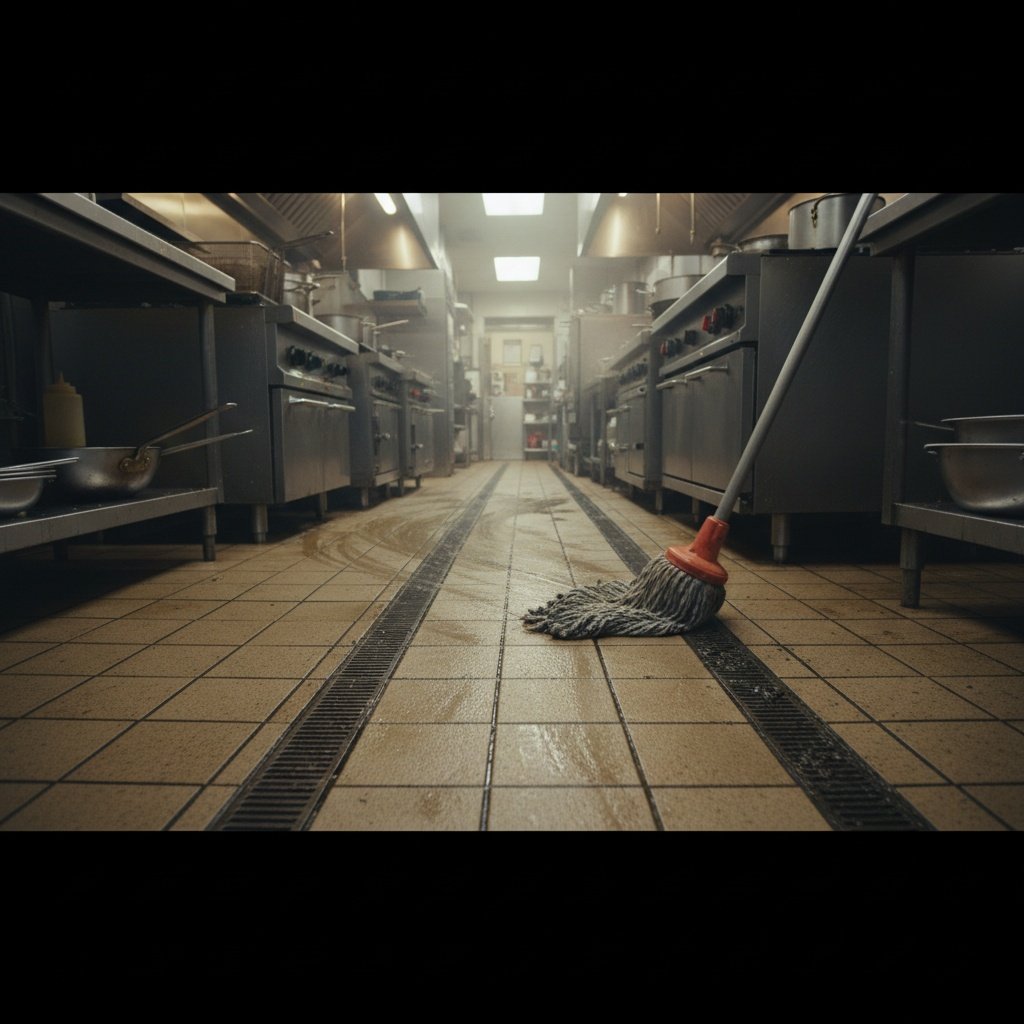
Health departments understand these challenges. They don’t expect perfectly white grout, but they do require floors that can be sanitized effectively. When grout becomes saturated with organic material, it can’t be sanitized with surface cleaning alone. That’s when violations appear on inspection reports.
Health Code Requirements for Restaurant Floor Cleaning
California health codes require restaurant floors to be smooth, durable, and easily cleanable. More specifically, Retail Food Code section 114143 states that food preparation and warewashing areas must have floor surfaces that are non-absorbent and smooth.
Grout creates a compliance challenge because it’s inherently porous. Once grout absorbs grease and food particles, it technically violates the non-absorbent requirement. Health inspectors recognize this reality, which is why they focus on whether floors are maintained in a sanitary condition rather than penalizing every grout line that shows age.
Regular professional cleaning demonstrates good faith effort to maintain sanitary conditions. Inspection reports improve when floors show evidence of deep cleaning, not just daily mopping. Many restaurant owners schedule commercial tile cleaning restaurant services quarterly or semi-annually specifically to maintain compliance and avoid violations.
Pro Tip: Schedule your professional tile cleaning about two weeks before your anticipated health inspection. Floors will still look clean during the visit, and you’ll have documentation of recent maintenance if questions arise.
Beyond health codes, clean floors reduce liability exposure. Grease buildup creates slip hazards that lead to worker compensation claims and customer lawsuits. Professional cleaning removes the residue that causes these accidents, making your kitchen safer for everyone who works there.
What Professional Restaurant Tile Cleaning Involves
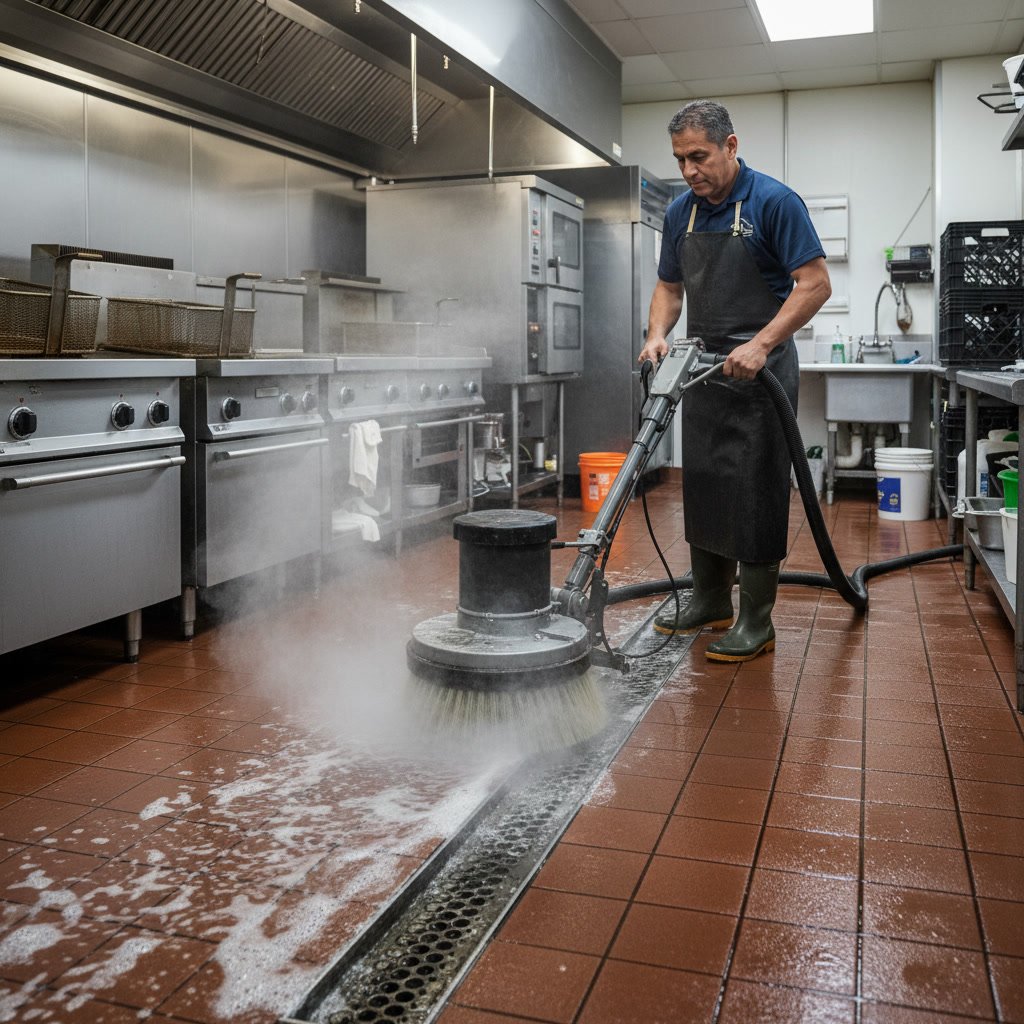
Professional commercial tile cleaning restaurant services use equipment and techniques that go far beyond what’s possible with mops and buckets. The process typically includes five distinct phases, each designed to address specific contamination issues.
Pre-Treatment and Degreasing
Technicians apply commercial-grade degreasers formulated for food service environments. These products break down oils and fats that have bonded to tile and grout surfaces. Pre-treatment solutions dwell for 10 to 15 minutes, allowing them to penetrate and emulsify stubborn grease deposits.
This step is critical in restaurant kitchens where grease accumulation exceeds what residential products can handle. Industrial degreasers contain surfactants and enzymes that literally digest organic material, converting it from a solid or semi-solid state into a liquid that can be extracted.
High-Pressure Hot Water Extraction
After pre-treatment, technicians use truck-mounted or portable extraction units that deliver water heated to 200 degrees or higher at pressures exceeding 1,000 PSI. This combination breaks apart contamination at the molecular level and flushes it out of grout pores.
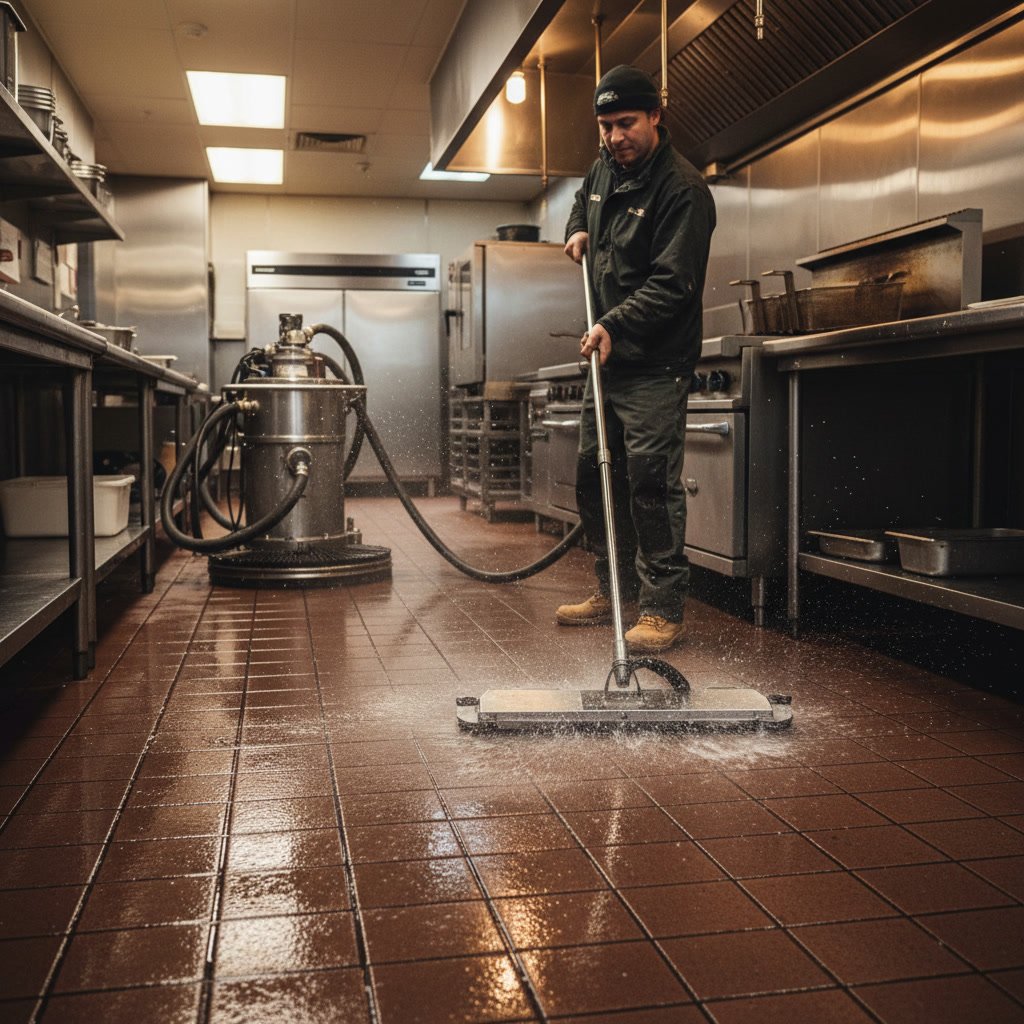
The extraction process is methodical. Technicians work in small sections, typically three to four square feet at a time, ensuring every inch receives adequate attention. They make multiple passes over heavily soiled areas, changing water and adjusting pressure as needed.
Grout Scrubbing and Detail Work
Even with high-pressure extraction, some grout lines require mechanical agitation. Technicians use specialized grout brushes, some powered by compressed air or electricity, to physically scrub away deeply embedded stains. This step is especially important in kitchens where grout has gone years without professional attention.
Corner areas, edges along walls, and spaces around equipment receive hand detailing. These zones often harbor the worst buildup because mops can’t reach them effectively during daily cleaning.
Sanitization and Rinsing
After extraction and scrubbing, technicians apply food-safe sanitizers that kill bacteria, viruses, and other pathogens. Health departments recognize quaternary ammonium compounds and other EPA-registered sanitizers as acceptable for food service environments.
Final rinsing removes all cleaning product residue. This step is essential because residue attracts dirt and creates the sticky film that makes floors look dirty again within days. Proper rinsing leaves floors truly clean, not just visually improved.
Sealing and Protection
The final phase involves applying penetrating sealers to grout lines. These products fill the microscopic pores in grout, creating a barrier against future contamination. Quality sealers don’t change the appearance of grout but dramatically extend the time between professional cleanings.
Sealers typically last six to twelve months in restaurant environments, depending on traffic levels and cleaning practices. Resealing during each professional cleaning maintains continuous protection and makes daily maintenance more effective.
Frequency Recommendations for Restaurant Kitchen Floors
How often your restaurant needs professional tile and grout cleaning depends on several factors. Kitchen size, menu type, customer volume, and daily cleaning practices all influence the appropriate schedule.
High-volume restaurants with significant frying operations typically need service every three months. Fast-food kitchens, burger joints, and any establishment that cooks with large amounts of oil falls into this category. Grease accumulation happens so quickly that quarterly cleaning is essential for maintaining both safety and compliance.
Mid-volume restaurants with moderate grease production can usually extend to semi-annual cleaning. Family dining establishments, casual restaurants, and cafes that don’t rely heavily on deep fryers often find that cleaning twice per year keeps floors in acceptable condition.
Low-volume or specialty restaurants might manage with annual professional cleaning, supplemented by rigorous daily maintenance. Coffee shops with minimal food preparation, bakeries, and similar operations generate less floor contamination and can often maintain standards with less frequent intervention.
Key Takeaway: Start with quarterly service and adjust based on results. If floors look good at the three-month mark, you might extend to four or five months. If they’re badly soiled before 90 days, increase frequency or improve daily maintenance procedures.
Seasonal businesses may benefit from pre-season and post-season cleanings rather than fixed quarterly schedules. This approach ensures floors are pristine when customer volume peaks and gets them ready for off-season storage or reduced operations.
Cost Factors for Commercial Restaurant Tile Cleaning
Professional commercial tile cleaning restaurant services typically range from 75 cents to $2.50 per square foot, depending on soil level, tile type, and accessibility. Most restaurant kitchens fall between $300 and $800 per cleaning for spaces ranging from 400 to 1,000 square feet.
Several variables affect final pricing. Heavily soiled floors require more time, additional product, and repeated passes to achieve acceptable results. Kitchens that have never received professional cleaning or haven’t been serviced in years often cost 30 to 50 percent more than well-maintained spaces.
Tile type matters too. Standard ceramic and porcelain tile clean relatively easily. Natural stone tiles like slate or quarry tile may require specialized products and gentler techniques, which can increase labor time. Textured or slip-resistant tiles with raised patterns trap more soil and demand extra attention.
Equipment access affects efficiency and therefore cost. Open kitchens where technicians can position extraction units close to work areas cost less than kitchens where equipment must be staged far away, requiring longer hose runs. Sites where heavy equipment can’t be moved may require additional labor to work around obstacles.
Many professional cleaning companies offer discounted rates for recurring service contracts. Committing to quarterly cleanings might reduce per-visit costs by 10 to 20 percent compared to one-time service pricing. This approach benefits both parties since scheduled maintenance is easier and more profitable than emergency deep cleans.
When evaluating proposals, compare what’s included in the quoted price. Some companies include sealing and sanitization, while others charge these as separate line items. Ask whether the quote covers moving portable equipment or if that’s your responsibility. Clarify whether multiple technicians will work simultaneously to minimize disruption during business hours.
Benefits Beyond Clean Floors
Professional tile cleaning delivers advantages that extend beyond visual improvement. These benefits often justify the investment even when floors don’t look terrible to the untrained eye.
Slip-and-fall incidents decline significantly after professional cleaning. Insurance companies recognize this correlation, and some offer premium reductions for restaurants that document regular professional floor maintenance. Even without insurance discounts, avoiding a single worker compensation claim typically pays for years of professional cleaning.
Kitchen staff morale improves when they work in clean environments. Employees take more pride in their workspace and often extend that care to their own cleaning responsibilities. The difference might seem subtle, but managers consistently report better daily maintenance habits after professional cleanings.
Equipment lifespan extends when floors stay clean. Grease tracked from floors gets onto equipment bases, wheels, and lower components. This contamination accelerates corrosion and mechanical wear. Clean floors mean less contamination transfer and longer-lasting kitchen equipment.
Customer perception matters, even in back-of-house areas. Dining room guests who glimpse the kitchen through service windows or open designs form impressions based partly on floor cleanliness. Food delivery drivers, health inspectors, and vendors all see your kitchen and form opinions about your operation’s overall quality standards.
Similar to how many businesses maintain their front-of-house carpet cleaning schedules, smart restaurant operators treat kitchen tile cleaning as a regular maintenance item, not an emergency service to call only when problems become severe.
Choosing a Commercial Tile Cleaning Provider
Not all cleaning companies have the equipment, products, or experience necessary for restaurant kitchens. Residential tile cleaning differs significantly from commercial food service work. Several factors separate qualified providers from those who should stick to residential work.
Look for companies that specifically list commercial restaurant cleaning in their service offerings. General carpet cleaning companies might claim they can handle tile, but without commercial experience, they’ll lack the industrial-grade equipment and food-safe products necessary for proper results.
Ask about insurance coverage, specifically whether their general liability policy covers food service environments. Restaurant work carries different risks than residential jobs. Proper coverage protects you if something goes wrong during the cleaning process.
Request references from other restaurants, ideally establishments similar to yours in size and menu style. Talking to other restaurant owners provides insight into reliability, work quality, and how the company handles scheduling challenges.
Verify that the company uses food-safe, environmentally responsible products. Health departments require that any chemicals used in food preparation areas meet specific safety standards. Grasso Carpet Cleaning uses environmentally safe products across all services, an approach that aligns with health code requirements and protects your staff and customers.
Consider local providers who understand regional health department expectations. Companies serving Escalon, Patterson, and surrounding San Joaquin County communities know what local inspectors look for and can address those specific concerns.
Ask whether the company offers flexible scheduling that accommodates restaurant hours. Kitchen cleaning often needs to happen late at night or early in the morning when food preparation isn’t underway. Providers accustomed to residential hours might not offer the scheduling flexibility restaurants require.
Maintaining Results Between Professional Cleanings
Professional cleaning creates a clean baseline, but daily practices determine how long results last. A few simple changes to routine maintenance extend the benefits and reduce long-term costs.
Sweep or vacuum before mopping. Dry soil removal prevents you from creating mud that gets ground into grout. This extra two minutes saves hours of scrubbing later.
Use quality degreasers in your mop water, not just all-purpose cleaners. Restaurant supply stores sell concentrated products designed for food service environments. These products cost more than generic cleaners but actually remove grease instead of just moving it around.
Change mop water frequently. Dirty water deposits contamination back onto floors rather than removing it. In busy kitchens, you might need to change water two or three times during a single mopping session.
Address spills immediately. Grease and food debris that sit for hours become exponentially harder to remove. Quick cleanup prevents stains from setting and reduces the load on both daily mopping and professional cleaning.
Use entry mats and require clean shoes in the kitchen. Soil tracked in from outside areas is often harder and more abrasive than food-related debris. Reducing outside contamination protects your floors and extends sealer life.
Just as businesses might maintain their upholstery cleaning schedules or stay current with dryer vent cleaning for safety reasons, consistent daily floor maintenance should be part of your standard operating procedures.
Frequently Asked Questions
How long does professional restaurant tile cleaning take?
Most restaurant kitchens between 400 and 800 square feet require four to six hours for complete cleaning, including prep, cleaning, and drying time. Heavily soiled kitchens or those receiving their first professional cleaning may take eight hours or more. Technicians can work around your schedule, typically arriving after close and finishing before morning prep starts.
Can we use the kitchen immediately after cleaning?
Floors are usually dry enough for light foot traffic within two to three hours after cleaning. Full curing of sealers takes 24 hours, so you should avoid heavy equipment traffic or deep cleaning during that period. Most restaurants schedule cleaning after closing, allowing overnight drying time before morning operations resume.
Will professional cleaning remove all stains from grout?
Professional commercial tile cleaning restaurant services remove the vast majority of contamination, typically restoring grout to 80 to 95 percent of its original color. Some permanent staining may remain in extremely neglected kitchens or where certain chemicals have reacted with the grout itself. Even when perfect restoration isn’t possible, cleaned floors look dramatically better and meet health code sanitation standards.
How does professional cleaning compare to replacing tile and grout?
Professional cleaning costs a fraction of replacement and delivers results that often last years with proper maintenance. Tile replacement runs $8 to $15 per square foot for materials and labor, compared to $1 to $2.50 per square foot for professional cleaning. Unless tiles are cracked or grout is structurally damaged, cleaning is almost always the better financial choice.
Do we need to move kitchen equipment before cleaning?
You’ll need to move any portable equipment like prep tables on wheels, rack shelving, and mobile carts. Professional cleaning companies typically don’t move heavy equipment like ranges, ovens, or walk-in coolers. Discuss accessibility during the initial cleaning consultation so technicians can plan the most efficient approach for your layout.
Local Commercial Tile Cleaning in Escalon and Patterson
Restaurant owners in Escalon, Patterson, and throughout San Joaquin County face unique challenges with hard water, agricultural dust, and the region’s temperature extremes. These factors accelerate floor deterioration and make regular professional maintenance even more important than in other climates.
Working with a local provider means faster response times when you need emergency cleaning before an inspection or after a particularly messy service. Local companies understand seasonal business patterns and can adjust scheduling to match your slower periods.
Grasso Carpet Cleaning has served the Manteca area and surrounding communities for over 50 years. That longevity reflects a commitment to quality and customer satisfaction that newer companies can’t match. The same family values that guide residential work apply to commercial services, meaning your restaurant receives the same careful attention as any other client.
For restaurant operators who maintain multiple locations, Grasso also provides services throughout the region, including work similar to their commercial carpet cleaning for schools and offices in Stockton. This regional reach means you can work with a single trusted provider across all your locations.
Schedule Your Restaurant Kitchen Tile Cleaning
Clean floors form the foundation of a safe, compliant, and professional restaurant kitchen. Regular commercial tile cleaning restaurant services protect your investment, reduce liability, and demonstrate your commitment to sanitation standards that keep customers safe and health inspectors satisfied.
Whether your restaurant operates in Escalon, Patterson, or surrounding communities, Grasso Carpet Cleaning brings five decades of experience and a 100 percent satisfaction guarantee to every job. The company’s environmentally safe products meet all food service requirements while delivering the deep cleaning results your kitchen deserves.
Contact Grasso Carpet Cleaning at +12092392906 to discuss your restaurant’s floor cleaning needs and schedule a service appointment that fits your operation’s schedule.